"Traveling is a brutality. It forces you to trust strangers and to lose sight of all that familiar comfort of home and friends. You are constantly off-balance. Nothing is yours except the essential things- air, sleep, dreams, the sea, the sky... all things tending towards the eternal, or what we imagine of it."
Speaking of jobs, here's a timeline of my dream jobs throughout the years:
1995: Fireman (unless the fireman's suit for Christmas was just for kicks) 1998: Pro Inline-Skater (Disney's BRINK! anyone?) 2000-2002: Marine Biologist (this got axed when I realized I hated math. But I still want to hang with whales) 2002-2007: Journalist <<2006-2008: actual job: working at a Dairy, how Pennsylvanian of me.>> 2007-2008: no aspirations except for making it in Oregon 2008-mid-2009: Journalist again. (Decided to go to UO for their excellent journalist school in 2009. Changed my mind, and became "Undeclared" one term in.) <<2009-present: actual job: working in the History Department, though not a history major>> 2009-2010: Some sort of International/Spanish (no actual idea) work 2011-present: Linguistics? Diplomat? School teacher? (How can I fit whales into this?)
Things have definitely changed. And more than ever if someone asked me what I want to be (when I grow up?), I wouldn't have an answer for them. And I think that's a good answer. Why do I have to know now? I'm going to graduate and have some more fun! I'm going to defer my loans and do things I love. Hell, I may even try to teach whales Spanish. I think it would be a blast and completely unproductive. Perfect.
Sometimes I can't believe I've been back in the USA for 6months. I still miss Chile every day. Just like my 6months went by fast in South America, they are speeding by now. However, time is flying in a whole new direction. In 6months (again!) I am hoping to be graduated from the University of Oregon. And guess what! I just applied for my first after-graduation job...In Spain...for 3 years. I'm really hoping I get it. Not to brag but I think I'll be pretty qualified with my major in Spanish and a certification of Second-Language Teaching. I would be teaching English in a school of currently indeterminable age and in an indeterminable location. But who cares! It's Spain! My main plan for the near future is to continue improving my Spanish and to gain experience for a future job (also indeterminable). Sooo that would be awesome. I should find out in late March!
On another note, all is well here. I'm busy like crazy with work, school, and my current internship which is being a classroom helper in an ESL class for immigrants that don't speak a lick of English. I've never been so busy, but I enjoy it all. Now that my classes are more specialized to my studies (higher level/non-general ed), they are extremely interesting and pertinent. Also I've started taking a spin class which, if anyone knows, sucks out your soul every time, and getting back into climbing! Currently I am on the hunt for good snow...
Wow! So today is our first day with internet back at the house, my first day back at work, and the day I finally got money back from the bank after it was all stolen from my account. Being back in the United has been...an experience. It was fun and exciting at first..I loved seeing friends and family, moving back into my house, sleeping in my bed, unpacking my suitcase, cooking for myself..but now the reality is setting in. And responsibilities are moving in. I have very mixed emotions. I loved my time in South America and really started establishing a life there. It was, and still is, to have been taken away from it and placed so far away. I now have far too many good friends that live far too far away. I miss them, my Valdivian family, the slow lifestyle that lets you enjoy the life you experience anew each day. I comfort myself knowing I will be back there soon.
School starts in a week here and I am taking three classes in Spanish which is good because for as much trouble and head ache it gave me sometimes, I really miss speaking Spanish every day.
I'd like to write a post summing up my experiences and feelings, but not today. I'm still sorting them out..
love to everyone I've met and said goodbye to..we will see each other again soon
How do I start? The trek was amazingly beautiful and difficult. We started out on the 21st optimistic and nervous. We ended on the 24th tired, but incredibly happy. Though at some points we thought we couldn't make it (day 2, 14,535 ft above sea level), we did eventually. The views were stunning and Machu Pichu did not disappoint: turning from mysterious alluring fog to gorgeous blues and green. We met 15 amazing people from Peru, England, Australia, the Falkan Islands, South Africa, Hawaii, and Germany. We learned some of the local culture and language-
Quechua: Allinllachu (how are you?) Allillanmi (I am fine) Wiñay Wayna (Forever Young- thanks to my guide, Javier)
The best I can do on this blog post is put the official itinerary and add a bit of my own. I'm still processing it all! Check out my facebook for more photos!
hiking hiking all day long
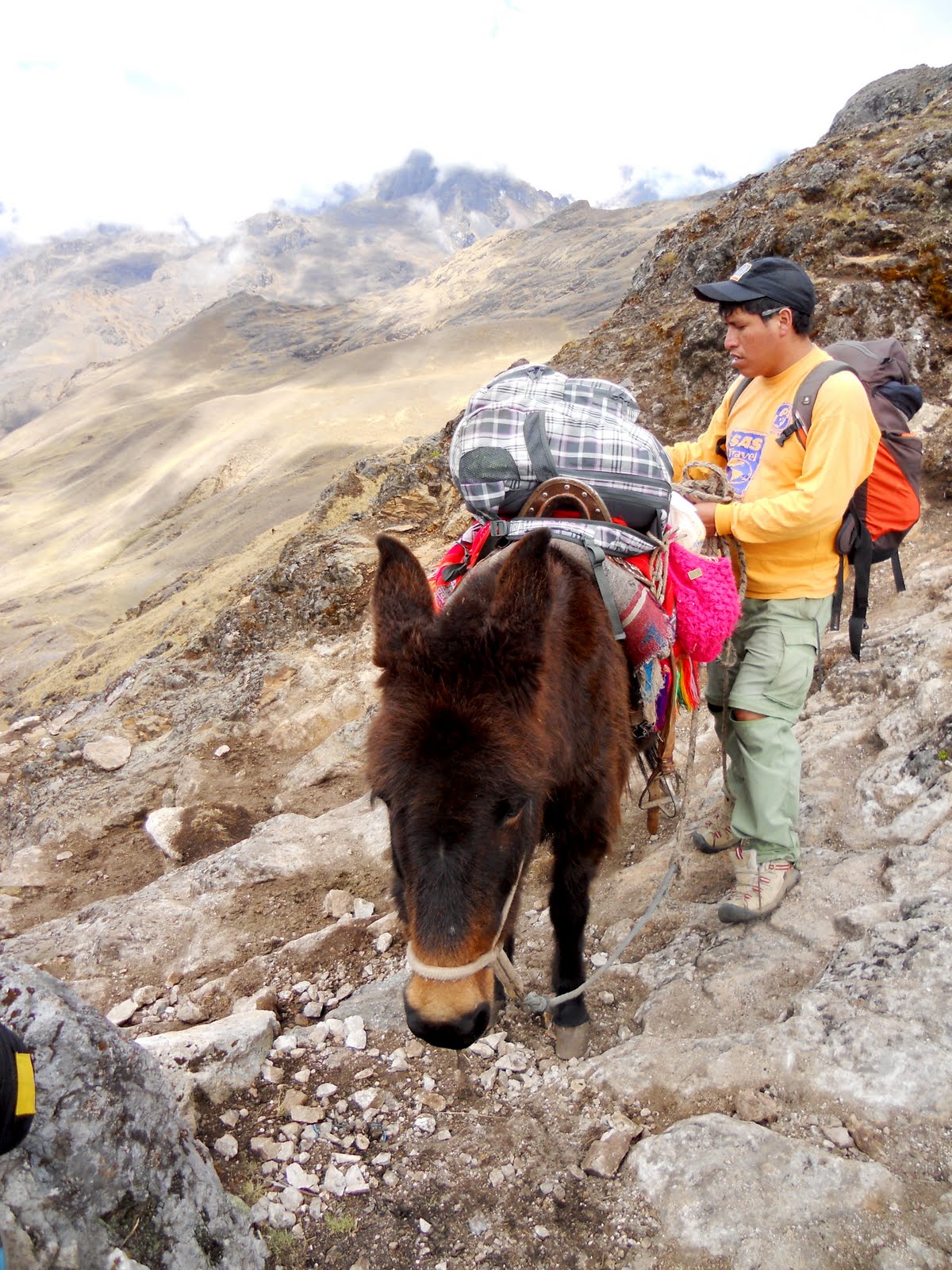
Napoleon
I now know the difference between llamas and alpacas by sight
First breakfast on the trek (2nd day)
14,545 ft summit!
day 3 chilly wake-up, but I refused to wear pants
local family that we donated coca leaves to
Caroline: Machu Pichu crutches warrior
just hanging out at the 'Pichu
Machu Pichu in her glory
Program Itinerary
Day 1: Day 1: Cusco - Quishuarani (Lares) - Cuncani - Yanacocha 3800 masl
Our bus leaves Cusco at 05:30 sharp for a scenic drive through the Sacred Valley, passing through Pisac and stopping for a brief toilet break and the chance to buy any last minute snacks, water, etc in Calca, one of the towns in the valley. Here we bought bags of coca leaves to give to people we met in the mountains as gifts. Departing Calca around 06:45 we head off for the scenic drive to Quishuarani (12,150 ft) which is the starting point for the trek. Along the way you will be able to observe small Andean communities, spectacular mountain landscapes, herds of llamas and alpacas plus Campesinos (people of the local villages) in colorful costumes as is traditional with all villages around Lares major district. A box breakfast will be served en route around 9am with arrival to Quishuarani before 10am, where we will meet our arriero horses, handlers and trek staff. Our "cook" was actually a trained chef..3 course delicious meals every time. We commence our beautiful trek through the Andes with a "gentle" climb from 3700m to 4200 masl where we will arrive at the lagoon named Queuña Cocha and can observe Mount Sawasiray (5400m) and Colque Cruz (5600m). There is then a short, much steeper climb to our first pass, Hualcacasa (4400m) where Mount Veronica (5700m, a sacred Apu (Inca Sun god) mountain in this Valley) can often be observed in the high mountains, after which we descend for 30 minutes to reach our lunch destination beside the picturesque 'seven lagunas'. Following lunch we descend for a further 30 minutes through the community of Cuncani, then gradually ascend beautiful hillsides for 2 hours to reach our second pass, Qolqecasa (4200m). 30 minutes descent from here past lagunas and waterfalls till we arrive at Yanacocha, our campsite for the night around 4.30pm.
approx 14km
6-7 hours
Day 2: Yanacocha - Wakawasi - Mantanay 3900 masl
After our 6.30am breakfast we leave Yanacocha and will gradually descend for approx 2 hours until Chaqchapata (3950m). We will be able to observe potato crops, flocks of llamas and alpacas developed in this part of the Andes (part of the cameloid family) and the local communities of people who continue living in houses made of stones. Along the slope we can observe the campesinos of Chaqchapata and 30 minutes further on of Wakawasi. Finally, we ascend for approximately an hour to reach the highest point of our trek, the passage of Auroracasa (4600m- 14,535 ft) where we will observe the lagoon Auroracocha. From Auroracasa we will descend to walk near two lagoons & traverse one more pass to enter the valley of Queuñas. We will notice a wide change in scenery before arriving at our beautiful campsite in Mantanay (3900m) after approx 2 hours. We did all this before lunch which worked out "well" since during Caroline's wade in the river, she stepped on a broken glass bottle and cut a large gash on her foot. Javier, our guide, patched her up using egg membrane as an antibiotic.
approx 16km
7-8 hours
Day 3: Mantanay 3900m to Yanahuara 2700 masl
After breakfast we start our walk at 7:30 am with a much easier day ahead as we descend to lower altitude & enjoy amazing views of part of Moray Maras and Salineras, mountains and the queuñas bush valley. You will notice the sudden change of weather and environment & observe local campesinos farming different crops of corn, potatoes and local vegetables to sell later in villages in the Sacred Valley. This walk will take approx 4 hours to reach the picturesque village of Yanahuara where we enjoy the last lunch in our trek and farewell our staff, arrieros horses, handlers, cooks and assistants. A private bus will then take us for the 30 minute ride to Ollantaytambo train station where we will board the train for the 2
hour trip with our tour guide to Machupicchu town, Aguas Calientes. Carolina was carried on Napoleon the spare mule until we got to Aguas Calientes where she got stitched up and was given crutches. That night I went out with Javier, Dalmiro, and another of the girls to do some Karaoke and dancing before the early wake-up call in the morning. Ashley was not amused when I burst into the room and woke her up to make sure I was in the right one.
Early breakfast (05.00am) before taking the 5.30am bus directly to Machupicchu arriving around 06.00am.
We got up early and made it through the gates before sunrise. The fog was so thick, that seeing sun was impossible but it was a mystical sight when the fog shifted and you began to see different parts of the city. Later in the day, the sun burned down, illuminating the and heating the city of rocks. I also went up to the Sun Gates to look down upon the city and valley.
After looking over a few details, we realized we could either spend more days in Cuzco before the trek to acclimate, and then also have days after the Machu Pichu trek, or, for the same amount of money, take a quick side trip to Lake Titicaca. While we were cowering at the 11,500ft of Cuzco that we were about to start a 4 day trek at, Lake Titicaca, or Puno as the town on the Peru side is called, is located at 12,500 ft above sea level. We figured going 1,000 ft higher and then coming down might just trick our bodies into thinking we were still at a relatively sane altitude.
On the 17th, we took an evening bus to Puno and one scary back road taxi drive later, ended up at our hostel around midnight. With our hostel, we booked our tour for 6:45 the next morning. Our roommate taught us a card game and then we went straight to bed.
The next morning, we had some delicious fresh pancakes and headed to boat launch. Lake Titicaca is the highest navegable lake in the world and also the largest lake in South America. An english steamship from the 1860's still sits in the Puno Bay. Our boat tour first went to Uros Island, one of the famed Floating Islands
The Floating Islands are about 44 in number and constructed by a reed that..floats. The islands were first constructed by Aymara people escaping Inca and then Spanish control. They use the soil under the reeds for stabilization and then add more and more reeds on top. Their houses and boats are made of the reed as well.
eating the reed, Totura..tasted like sweet iceburg lettuce
On the left- women working
On the right- ancient gods
With one of the women of the islands
The second island we went to was called Isla Taquile, which is located out in the main lake. The lake is split in two by the Peruvian and Bolivian borders. Obviously, we stuck to the Peru side since we didn't have visas to enter Bolivia. At this island, we walked up to the summit, admiring the terraces of agriculture and the simplicity of life. We had lunch, watched two traditional dances (one of the cycle of farming and the other on the wooing of a partner), and learned about the island's main crafts, hat making! (Once I find the information I took on it I will include it.)
At Isla Taquile
Overall, a nice trip out in the sun. The next morning we got up early, again, and headed to Cuzco!
We just made it to Lima, Peru after 21 hours by bus from Cuzco. It's Monday night and Wednesday night we leave. Just like before I left for Chile, every hour my emotion changes from wanting to get home and wanting to stay here. That's what I get for creating two lives that I love so far apart. I wish I didn't have to leave so many great people.
From Arica, we crossed the border to Peru in a little crowded bus into Tacna, Peru's border town. We transfered there onto a bigger bus headed to our first Peruvian city stop..
We got into Arequipa, The White City, in the late afternoon to a hostel called "The Point". There are several Points in Peru, located in all the main cities. It is a chill place, more graffiti on the wall, foosball, pool, hammocks, and a hot tub. We had come to Arequipa purposefully on the night before the 15th, since that was the day of the festival of the Arequipenas, the native settlers of the area, and their still thriving culture in the city. However when we got there, we found out that yes, the festival was the next day, but tonight was the night everyone went out to party. What else was there to do but grab a bite to eat, freshen up a bit, and go out! We left for the central plaza, Plaza de Armas, and ran into a huge crowd. Fortunately we made it to a rooftop bar where we had our first drinks of Peru. It was quite a learning experience when I was thinking of having a Piscola, or a pisco with coke, and was told by one of the guys I was with that they Never made those in Peru..it was a travesty to put cola with pisco. Knowing Chile and Peru's long argument over all things pisco, http://en.wikipedia.org/wiki/Pisco I held my tongue and asked them to suggest one. Thus began my trend for Peru's Chilcano (pisco, grenadine, and lime). In the morning we headed out to the parade that wound through the city. It featured groups from all different southern and central american indigenous groups. We found ourself a nice window ledge to perch on, but still couldn't see very well. The rest of the day we wandered around and rested in the hostel's bar and hammocks.
Dancers in costume
The Point hostels are known for being party houses. That night we played their famed "Giant Jenga". The blocks were literally the size of bricks and the tower started around shoulder-height. The rules were as follows:
Too Easy- 1shot Too Long (time)- 1shot Wrong Way- 1shot Two Hands- 1shot Knees- 1shot
You weren't able to get through a turn without having to take at least one shot. Even if you thought you had done well, the "judge" usually gave you a shot for doing something "stupid" or too easy. You only had to pay for the shots if you lost. After about 10 people, during your turn you would have to wear a hardhat in case the tower fell and for most, use a step-stool to reach the top. After jenga, there was limbo, and then some crazy dancing.
Never lost!
After we all got ourselves out of bed the next morning, myself, Ashley, and three others from our room headed out to do some more exploring. We first went to the Museo Santuarios Andinos where Juanita the Ice Princess is kept. Juanita was about 12 years old in the late 1400's when she was sacrificed on top of Mt. Misti as a sacrifice to the gods from the Incas. At one point, the ice where she had been buried melted and re-froze again, preserving her in ice. http://en.wikipedia.org/wiki/Mummy_Juanita There was a funny moment when the guide asked our group where we were from..After stumbling for a bit, we just replied that we spoke english. Though she looked at us weirdly, it would have taken longer to say "these three from America, she's from England, and he's from Australia."
It's been great being with people from all other the world and Ashley and I have really enjoyed picking up some non-US english slang too!
Arequipa and Mt. Misti
We also went to the Convento de La Recoleta which is a Franciscan convent founded in 1848.IT features rooms of art from all decades and to top it all off, a huge library consisting of over 20,000 ancient texts.
Unfortunately, on our last day here, while packing, I discovered my camera to be missing. It was never found and since Arequipa, I have been traveling camera-less. All the photos form this post and from now on, are all from Ashley's camera.
After Arequipa, we took a quick and unplanned detour to the highest navigable lake in the world, Lake Titicaca.